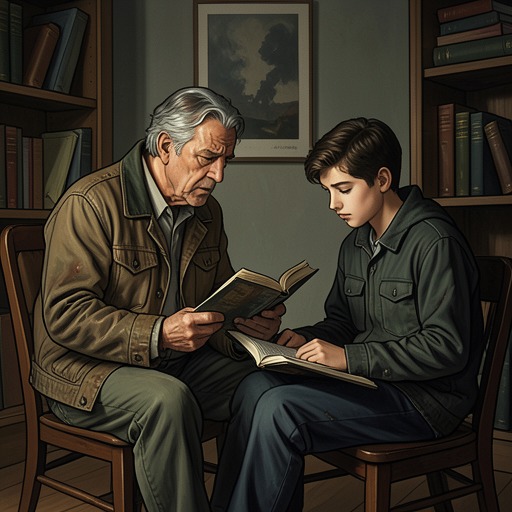
Peter finds his father's body and takes him down
The Power of the Dog (Thomas Savage Edition)Peter finds his father, Johnny Gordon, dead by hanging in an upstairs room and cuts him down from the rope. The discovery turns an ordinary call from Rose Gordon into the first moment in which Peter must face his father’s death alone, and it becomes the tragedy that will define the inn for those who hear of it.
Discovery Upstairs
After Johnny has gone upstairs, Peter later hears a noise and finds him there. The narrative establishes the death through Peter’s actions: he has already cut his father down when Rose calls for him from below. Johnny had hanged himself from one of the ropes coiled beside the window for escape in case of fire, turning an object kept for safety into the means of his death.
Rose calls Peter again and asks what he is doing upstairs. She believes Johnny is tired and whispers that Peter should try not to wake him. Her words reveal that she does not yet know he is dead; Peter, by contrast, has already encountered the fact she is trying to guard against. He answers that he will be right down, but does not tell her what he has found.
Peter’s Silence
When Rose approaches, Peter has the black pocket comb he always carries in his hand. He drags his thumb over its teeth repeatedly, a sound Rose finds chilling. Asked what he sees on the opposite wall, he stands looking past her and wonders how to tell her that he found his father and cut him down.
The scene gives no explanation for Peter’s silence beyond the difficulty of finding words for what has happened. Its dramatic force lies in the gap between Rose’s ordinary, protective concern and Peter’s knowledge of the death. He must move from the upstairs room toward a conversation that will make the loss known, but the account leaves that disclosure suspended in the moment before speech.
Aftermath at the Inn
News of the suicide draws neighbors and tourists to the inn. They identify it as the place where the death happened and, from the saloon, look across at the turning windmill. Rose runs the establishment as an eating house, but the stories surrounding the death leave her with few customers; diners imagine that the room where they eat may be directly beneath the place of the hanging.
The public aftermath contrasts with Peter’s solitary discovery: what he first could not put into words becomes a story outsiders attach to the building. Rose continues tending the place and its flowers, while visitors look for traces of tragedy in her and the boy. The death thus persists not only as a private family loss but as the inn’s defining public association.